Showing posts with label zinnia. Show all posts

Monday, November 5, 2012

seedlings and seedlings

Seeds will be obsolete if stored for far too long especially in the kind of weather we are having in Malaysia.  One eggplant was allowed to grow and grow and finally turned yellow. It was so big. I scooped out seeds, and it could easily be thousands.  I germinated immediately, filling up 104-tray. There is no intention of selling them at all, and the whole process is to satisfy my earlier hypothesis that fresh seeds will germinate better.

So, as expected every single seed germinated...... 104!. The most I am going to use is 20 in the vegetable patch over the left side of the backyard.... The rest is for the neighbours and visitors, - kakdah's green giveaways, in a down to earth reply to modern cry - sustainable living. Kakdah may not have the capacity to champion 500,000 strong march down Kuala Lumpur for green living or stop jungle clearing campaign. And all she has is the green pencil to give some colour to the canvas in form of little seedlings giveaways....


eggplant seedlings


two rows of zinnia on the left,  a tray of spinach on the right

After years of  germination attempts,  we can almost gauge what's the outcome, given the age of seeds and weather conditions.  My way is crude, no lab, no meter readings.... just plain layman approach. Like an old fisherman who can tell storm is coming, not repeating weatherman's report on TV but understanding the tingling feeling at ear lobes..... hmmmm...hmmm... haha.


___________________________
bangchik and kakdah
mylittlevegetablegarden

Monday, July 23, 2012

BUTTERFLY AND FLOWERS in the garden

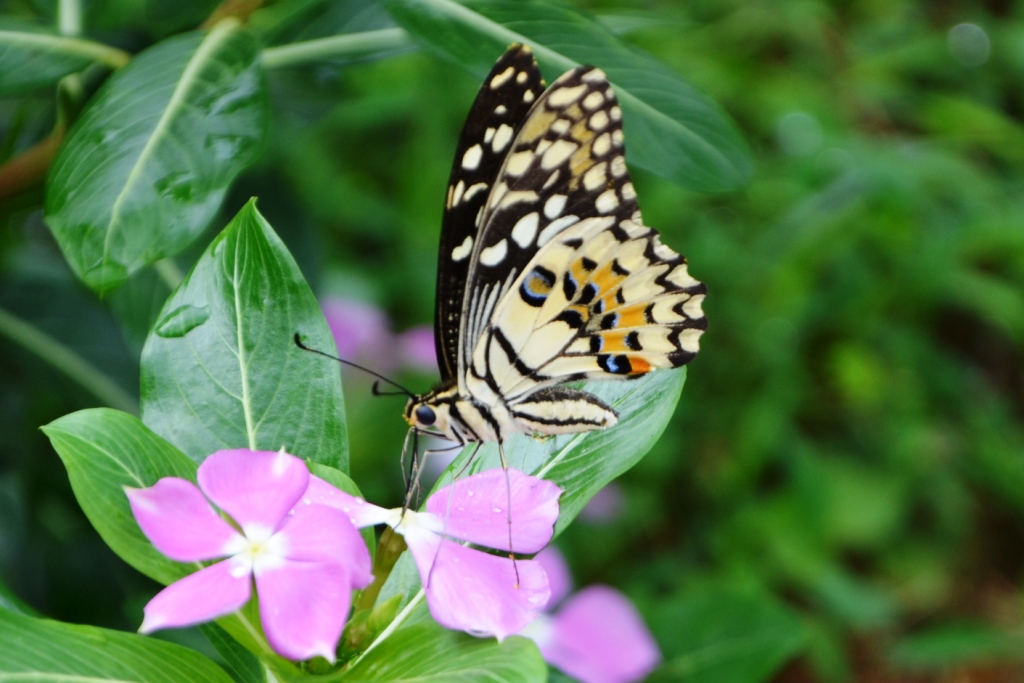
Papilio demoleus malayanus ((Lime Butterfly) is the name for butterfly in the first set of pictures. There is a lime tree nearby, for the moment without flowers. The butterfly is happy with periwinkle nectar, shifting from one flower to the next.


Papilio demoleus malayanus ((Lime Butterfly)
on periwinkle flowers

Papilio demoleus malayanus ((Lime Butterfly)

Papilio demoleus malayanus ((Lime Butterfly)

Papilio demoleus malayanus ((Lime Butterfly)

Papilio demoleus malayanus ((Lime Butterfly)

Papilio demoleus malayanus ((Lime Butterfly)

Papilio demoleus malayanus ((Lime Butterfly)

Papilio demoleus malayanus ((Lime Butterfly)


Striped Albatross (Appias libythea olferna)
on ulam raja flower

Striped Albatross (Appias libythea olferna)


Lesser Dart (Potanthus omaha omaha)
on zinnia single layer flower

Lesser Dart (Potanthus omaha omaha)

Lesser Dart (Potanthus omaha omaha)

There was also a yellow butterfly that day,
 but it moved so fast and kept changing directions
 that it was almost impossible to snap.


bangchik and kakdah
johor

Friday, April 1, 2011

on the ground

We dont have any plant that grows higher than the eye level, not counting kakdah's hanging orchids, and what by the end of the year, the four papaya plants would eventually be. To see flowers is to  look physically down, but flowers remain high in the aesthetic and emotional level. Kakdah will smile, temporarily getting out of whatever is negative and stressful in life, as she walk and lovingly hold the few flowers in the garden.

 flowering plants in clusters, balsam (keembung) and zinnia

Balsam, Malar's giveaways, zinnia from the old Putrajaya garden are flowering. The site is actually reserved for pandan which will soon conquer the area. For now flowerings are grown to fill the empty space.


 basil flowering

 basil getting quite bushy

Basil which is about to be a permanent feature here, is flowering too. The two basil at the back of the house are becoming more bushy after I did a complete pruning of all flower stalks. A few new flowers are coming up and are quite visible.


 a young ubi badak by the fence

 ubi badak, the shoots,
so tender looking.

 ubi itik, another tuber, is a climber too.
I don't know if it will ever produce flower.

 kiwi from seeds, first attempt.
at four leaves, they are growing steady. 
For now, i will let the eventual kiwi fruits grow in my dream.


Hop over to Katarina  to see more.


bangchik and kakdah,

Wednesday, July 14, 2010

A day of Zinnia.

Zinnia keeps coming back to our little garden. It can really reseeds itself around the base of the mother plant when the old plant is drying out.  The problem with reseeding is that we just cant tell, with little seedlings what colour would the flowers eventually be.
To the left of our car porch, there is an area dedicated to Zinnia. There were of different colours; white, pink, creamy, purple, red and light orange when we first started it. After a cycle, reseeding began to take place. We are used to see flowers with multiple petals layering themselves to the centre, almost like a crown.
Lately, our zinnia evolve into simple plants, producing single layer flowers.
I am not too sure, if the plants can still produce beautiful layered flowers like their grandmother plants.

 Today, is a day of Zinnia assembled in three parts.

Part One


 A bud


A little flower


A pair of Zinnia


A single flower


Part Two

almost white spiky petals

spiky petals


unfolding its petals


a flower with two more at a distance


a single flower

three in a row


Part Three

baby flower


elegant

sharp petals emerging

new and old

half way through

A pair 


bangchik

Tuesday, June 1, 2010

Zinnia and the cage


zinnia

 There is one plant at the side of the caged tomato.  Flowers are at various stage, and for a change, I pick  cage as the background for Zinnia.

a little bit   about Zinnia
For decades, zinnias have been the flowering annual of choice for spreading glorious colors throughout the garden as well as for cutting to bring indoors. But it wasn't always so. When the Spanish first saw zinnia species in Mexico, they thought the flower was so unattractive they named it mal de ojos, or "sickness of the eye!" What changes have been brought about over the years since--in flower colors and shapes, plant sizes, and disease resistance.

Even after seeds of zinnias were sent back to Europe in the 18th century, the plants were not much to look at. Named for Dr. Johann Gottfried Zinn, who wrote the first description of the flower, the genus Zinnia had to wait for the late 19th century to become more successful as a garden annual. Breeding by selection occurred in Germany, Holland, and Italy: 'Pumila Mixed' (precursors of the "cut-and-come-again" zinnias) and two selections from that strain, 'Mammoth' and 'Striata', were brought to this country and enjoyed great success with gardeners. But the start of the zinnia's real popularity began around 1920 when Bodger Seeds Ltd. introduced the dahlia-flowered 'Giant Dahlia'.

bangchik
Related Posts Plugin for WordPress, Blogger...