Showing posts with label winged beans. Show all posts

Monday, October 18, 2010

The end of winged beans

We are so used to life and death in gardening. It is part and parcel of the whole big kingdom of plants; to live and to die. Now is the turn for winged beans. What a life, a tiny seedlings in April, having  trellis to climb in May, fruiting in September and ready to go in October, in a space of  7 months. We have endless supply of crunchy winged beans over 2 months. Friends and neighbours are not forgotten.

trellis dismantled: the end of winged beans at the front porch

fresh winged beans: young and old.

fresh winged beans: sliced

 dry winged beans: seed pods open.

winged beans: the seeds.

The seed coat is hard,  therefore winged bean will take its own sweet time  to break and germinate. From previous attempts they seem to start off  well during rainy season when soil is wet and temperature a little bit cool.  Winged beans, just like any other bean plants has roots that affect the nitrogen level in the soil. the next plants, veggies or whatever would love the fresh and fertile soil, previously treated by winged beans.


bangchik


Tuesday, October 5, 2010

sweet corns, first to join.

Sweet corn is not new here. We grew sweet corns during the first half of  last year with some measure of success. Now sweet corns are coming back with a new role to play.  They form a major component as in the Legend of Three Sisters Garden. 

I am facing this problem again and again. Ten  old corn seeds failed to germinate except for one. Then I quickly rush to Mydin supermarket to purchase a new packet of sweet corns seeds.  Now the new seedlings join the sole representative of the earlier batch in the garden bed that was once filled with Ulam Raja, Marigolds, Amaranth tricolour, Spinach, peanuts and raddish. They are transplanted as in the design of Three Sisters Garden.with a little bit of modification.


the first trio of sweet corns.
Notice the bigger plant as the sole representative of the old seeds batch.
All sort of seedlings appear as a result of self seeding, mainly spinach, amaranth, and ulam raja. These will be pulled out and some will be scooped out to another location.


the second trio of sweet corns
Peanut plants are visible at the top. I think some peanuts 
from the earlier plants are still in the ground and they germinate. 
I am going to leave those in for a while 
before winged beans really grow.

So corns are the first to join the Legend of Three Sisters. 
Winged beans were sown direct into the ground and so far nothing happen yet. The third component is pumpkins, which are now in tiny pots. One seed has rooted and is pushing the first pair of leaves up. The rest are still quiet.
There will be regular updates on the development of Three Sisters.

bangchik
Putrajaya Malaysia

Thursday, August 19, 2010

Looking outside in on sisterhood.

winged bean viewed from the house, heavy and dense on the trellis

blooming coleus and roselle.
Coleus loves a little bit of shade.
For easy identification, roselle has leaves of darker green
compared to winged bean.

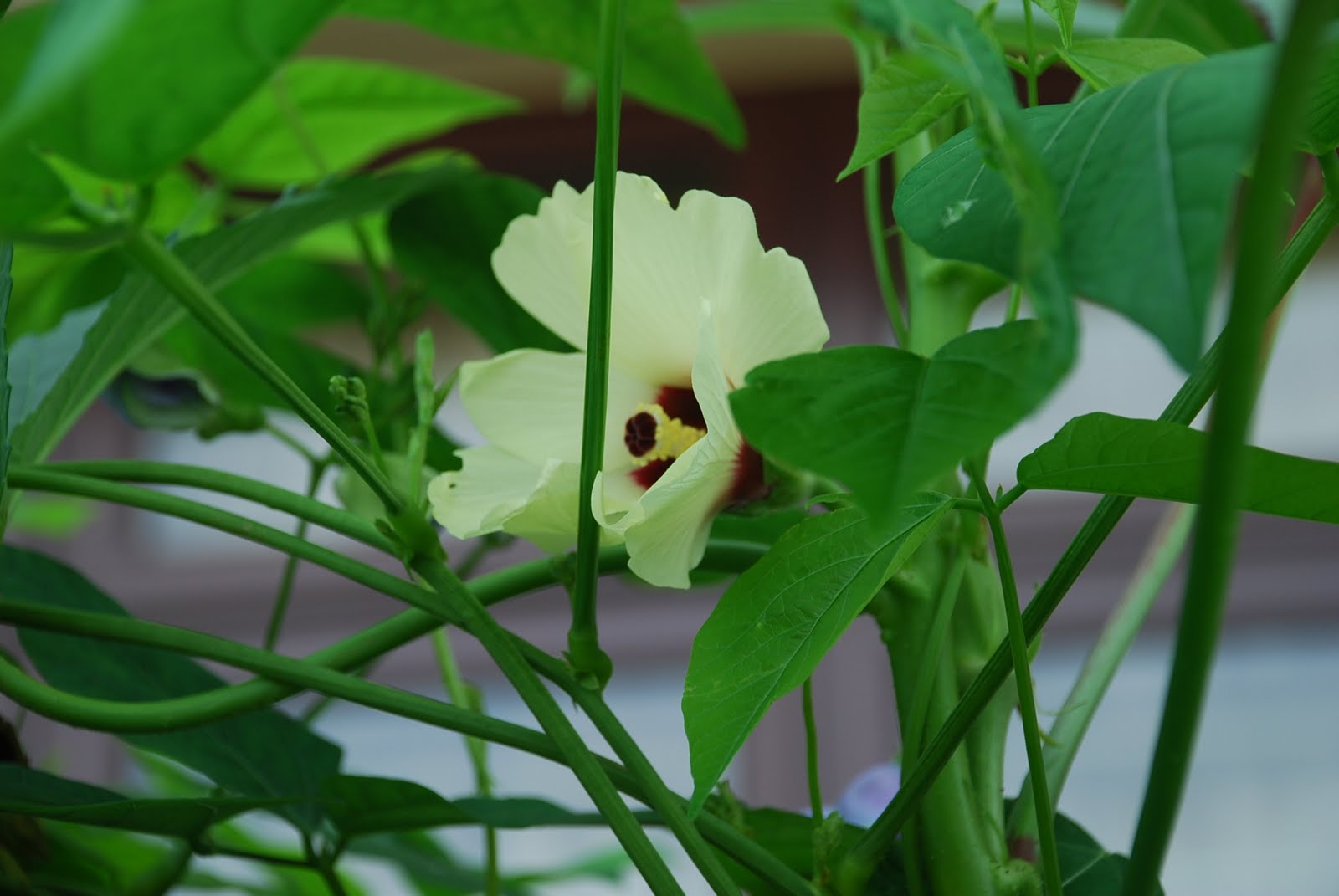
okra flower quite visible

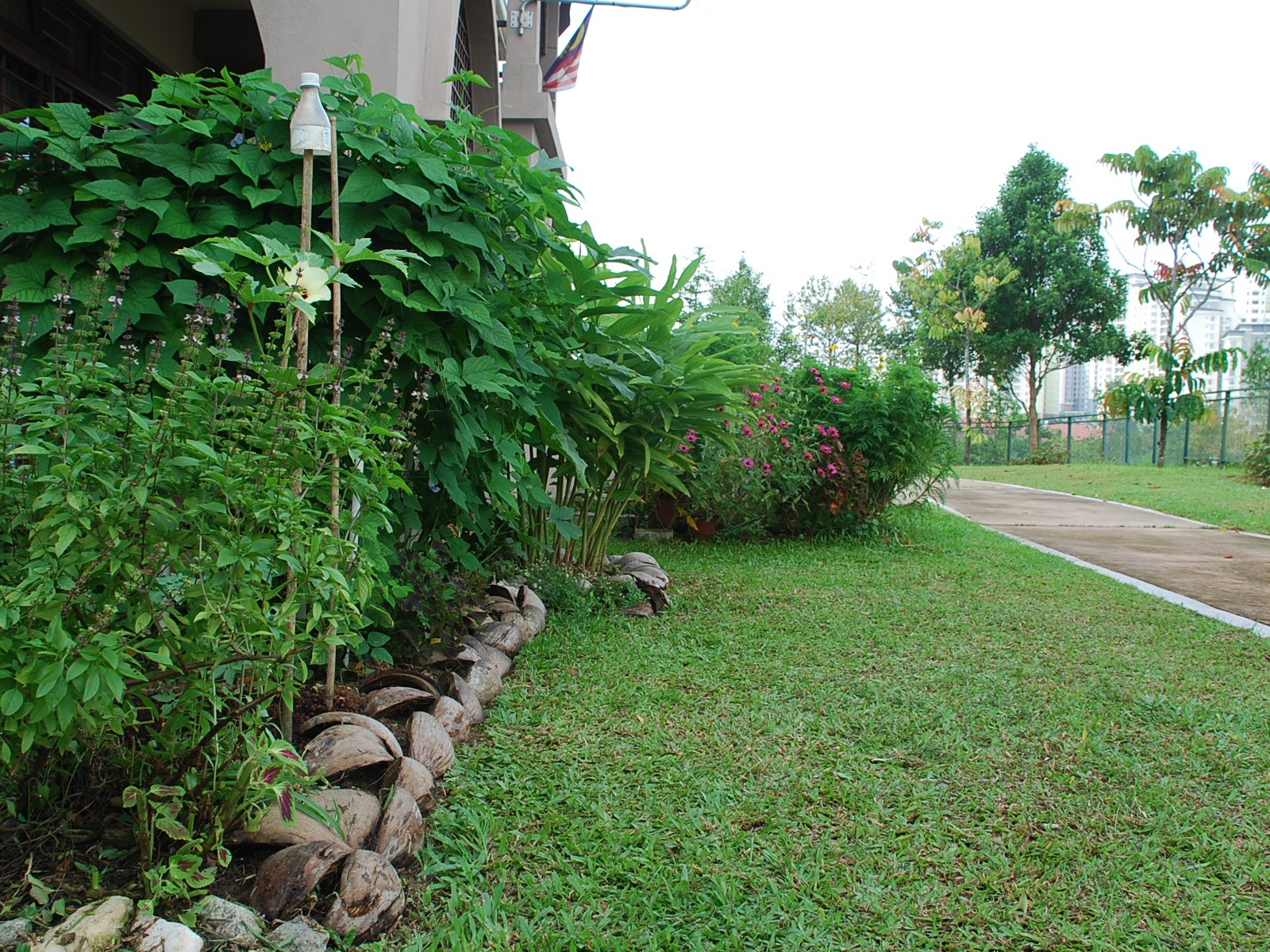
winged beans and all the companions.
Closest is lengkuas, or galangal or blue ginger which rarely placed at vintage spot,
always tucked somewhere at the back in most garden.

the view from the other end.


a wider view from the other end.
Closest  is basil with its columnar flower.


It is a little feminine to mention about sisterhood. We may want to say it as brotherhood, the bond, the companionship, or kinship. It is all about coexisting in a world where the most enterprising will go far. The earlier posts of  Unintended companionship of Okra, Roselle and Wing..., and   Okra get entwined as in the Legend of Three Sister... , scrutinise the delicate balance of companionship. The same hand that lends support will break the other's neck and suffocate.
To be fair, we do have to take another view, which is outside in to trace what lies within the companionship at a glance. Then we are looking at companionship on a bigger perspective. Soon the flowering and fruiting winged beans will go, okra will reach its finishing line along with roselle, zinnia, marigolds and ulamraja. In a couple of months, the look will be different, new plants in, different concept and colour scheme. The new plants will get used to different companions, for another sisterhood.

But lengkuas or galanga will stay, 
as an old man to relate stories about the do's and don'ts 
of staying together in harmony.


  bangchik and kakdah, Putrajaya Malaysia ~my little vegetable garden  


Tuesday, August 17, 2010

Unintended companionship of Okra, Roselle and Winged Beans.

okra flower facing the other side.
and a light blue winged bean flower quite visible somewhere at the bottom.

okra flower, another view, 
the stem is entwined by winged bean.

a branch of roselle, far away from winged bean.
on the far left is a portion of coleus leaf.

the main stem of roselle
caressed by winged bean.

roselle getting hooked by winged bean

The whole thing is an accident. They are grown for convenience, with space constraint in mind. I did an earlier post highlighting  the Legend of Three Sister.

Now the companionship is getting more pronounced. Surprisingly, the two roselle plants and a single okra are growing so well. The root nodules of winged bean must be feeding them with much needed nitrogen.
I hope the timing is perfect for meaningful coexistence, before winged bean runs wild and over run its companions. Of course we can intervene, and start pruning and reduce the little branches of winged beans that may hurt and suffocate the companions.


my little vegetable garden - bangchik

Monday, August 9, 2010

Okra get entwined as in the Legend of Three Sisters Garden.

okra get entwined

flowering okra 
with winged bean shoots going round.

I cant imagine okra will grow this tall judging by its look  last month.  Somehow, okra pushes up with zest, racing with the winged beans for vintage point of sunlight. At this height, okra will be vulnerable against strong gust of wind. Winged beans reach out and give lanky okra a helping hand....... and that brings us to the legend.

Iroquois legend of Three sisters garden
According to Iroquois legend, corn, beans, and squash are three inseparable sisters who only grow and thrive together. This tradition of interplanting corn, beans and squash in the same mounds, widespread among Native American farming societies, is a sophisticated, sustainable system that provided long-term soil fertility and a healthy diet to generations. Growing a Three Sisters garden is a wonderful way to feel more connected to the history of this land, regardless of our ancestry.
Corn, beans and squash were among the first important crops domesticated by ancient Mesoamerican societies. Corn was the primary crop, providing more calories or energy per acre than any other. According to Three Sisters legends corn must grow in community with other crops rather than on its own - it needs the beneficial company and aide of its companions. 
 The Iroquois believe corn, beans and squash are precious gifts from the Great Spirit, each watched over by one of three sisters spirits, called the De-o-ha-ko, or Our Sustainers". The planting season is marked by ceremonies to honor them, and a festival commemorates the first harvest of green corn on the cob. By retelling the stories and performing annual rituals, Native Americans passed down the knowledge of growing, using and preserving the Three Sisters through generations.
 Corn provides a natural pole for bean vines to climb. Beans fix nitrogen on their roots, improving the overall fertility of the plot by providing nitrogen to the following years corn. Bean vines also help stabilize the corn plants, making them less vulnerable to blowing over in the wind. Shallow-rooted squash vines become a living mulch, shading emerging weeds and preventing soil moisture from evaporating, thereby improving the overall crops chances of survival in dry years. Spiny squash plants also help discourage predators from approaching the corn and beans. The large amount of crop residue from this planting combination can be incorporated back into the mound at the end of the season, to build up the organic matter in the soil and improve its structure.
Corn, beans and squash also complement each other nutritionally. Corn provides carbohydrates, the dried beans are rich in protein, balancing the lack of necessary amino acids found in corn. Finally, squash yields both vitamins from the fruit and healthful, delicious oil from the seeds.
Native Americans kept this system in practice for centuries without the modern conceptual vocabulary we use today, i.e. soil nitrogen, vitamins, etc. They often look for signs in their environment that indicate the right soil temperature and weather for planting corn, i.e. when the Canada geese return or the dogwood leaves reach the size of a squirrels ear. You may wish to record such signs as you observe in your garden and neighborhood so that, depending on how well you judged the timing, you can watch for them again next season!
Early European settlers would certainly never have survived without the gift of the Three Sisters from the Native Americans, the story behind our Thanksgiving celebration. Celebrating the importance of these gifts, not only to the Pilgrims but also to civilizations around the globe that readily adopted these New World crops, adds meaning to modern garden practices
Success with a Three Sisters garden involves careful attention to timing, seed spacing, and varieties. In many areas, if you simply plant all three in the same hole at the same time, the result will be a snarl of vines in which the corn gets overwhelmed!
[source: guest author Alice Formiga Three Sisters Garden: Corn, Beans, Squash - A Native American]

bangchik and kakdah, Putrajaya Malaysia

Sunday, July 25, 2010

Kelisa is the name for many things.

Kelisa is the name of  three different things in Malaysia. 

1. For Kelisa, the name is primarily about 
a plant that is about to bloom in my little vegetable garden. It is also known as kacang botol or winged beans. Two plants are presently making trellis their home, becoming very dense and ready to sprout their first burst of flowers.

kacang kelisa near the car porch

kacang kelisa at the front of the house.

early indication of flowers in the making


2. Kelisa is also the name
of a locally manufactured car, very petite and very affordable to most. I think Perodua the manufacturer has stopped producing this model. We can still see kelisa on the road. The car is handy for town driving, you can just zigzagging leisurely.... haha.


kelisa car

3. Kelisa is also the name
of the most exotic looking fresh water fish. It is also known by the name Arowana. An inch long baby fish may fetch the price of a few hundred ringgit Malaysia. A foot long may cost more than what most can afford. Some matured kelisa are sold at 30,000 ringgit Malaysia. But the fish is just so exotic and lovely. Tasik Merah, in the north of Perak is the natural habitat of this particular fish. Some keep for the sheer beauty, but some keep it for luck ( chinese friends will say "ada ong")


kelisa fish
also known as Arowana

A blogger friend mentioned about her name coming from kacang kelisa. But I dare not include that as the fourth name for Kelisa. Anyway Lisa has no Ke at the front to qualify as the fourth specific name... haha.


bangchik

Sunday, May 23, 2010

Natural height for climbers

Winged bean plant, standing up refusing to bend and rest
(that man squatting is a municipal worker, looking after the landscape)

That brings us to a very important point. Does plants like winged beans which love climbing has its own natural height.  If i let the plant climb up a 100 ft coconut tree, I am not too sure if the plant is courageous enough to climb the whole height. It may just keep climbing and flowering and fruiting and die off before the maximun height is reached. Or it may just decides to reach a reasonable height and make it dense by growing around that height, branching, flowering and fruiting within the dense foliage.


The way that shoot in the picture trying to stand up on its tiny stem does give some indication of what is  the natural height. But the plant decides that it has gone enough, bends at the tip and ready to fall slowly and rests on top of the trellis.


bangchik

Thursday, May 20, 2010

Winged beans: at four locations

Winged beans or kacang kelisa  are growing at four different locations in our little garden. Two of them are allowed to grow with trellis to climb on. The other two are left on the ground to fend themselves. It does sound cruel and mean not to provide that two with trellis. It the wild, nature never provide trellis in front of their eyes or shoots rather. They crawl and crawl until they find something to climb on. It is nice to see winged beans going through life in different surroundings, a domesticated version and almost wild version.

 Trellis 1
winged bean
At the vegetable bed in place of the old tomato plants recently pulled out. Currently neighboring the aging sunflowers with bending neck


each stalk holds 3 leaves.


Trellis 2
winged bean 
at the front of the house with painted bamboo trellis


On the ground 1
winged bean
on the bed with banana on one end 
and pineapple on the other


On the ground 2
 winged bean
just a tiny one, guarded by old coconut husks.


Winged beans will take quite some time before they start flowering. So very long, that one could just about to give up. The plant will wait until the foliage becomes so dense, that fruits or beans will develop within the shade of its foliage. Winged beans understand it well....


bangchik

Thursday, December 24, 2009

The last of winged beans


I seldom allow plants to die standing. As soon as the plants are showing sign of old age, or serious pest attack, I will put emotion aside and pull  out the plants. Our winged beans are showing every sign of getting old. Leaves getting smaller, beans start to emerge in awkward shapes and pests seem to hover around for a big kill.

I pull the plants out and dismantle trellie.... and thats the last of our winged beans.

~bangchik
Putrajaya.

Wednesday, October 7, 2009

Between the two, flowers and beans


matured winged bean.


Flowers will end up as beans, but at times I love the flowers more
and
how I wish they stay a lot longer,
with their soft beautiful
bluish purple color.


~bangchik
Putrajaya, Malaysia

Tuesday, October 6, 2009

The beauty of winged bean plant


winged beans
on three legged trellis.

I read some where about winged beans being very independent. They survive even on the most hostile soil. It is suggested that their roots are fairly productive. Not only they take in water and whatever nutrients available, the roots  are also able to manufacture their own nutrients....

The photo was taken from the pedestrian walkway. This probably is the view seen by people walking up and down the walkway. Some mothers push their babies in prams. Even babies turn their eyes towards winged beans... haha. I wish I knew, what they were cursing at.... @#uo&////!! +-$#.....

I am very conscious about gardening in this neighborhood. I don't want neighbors to send complaint letters to the council about my garden being a nuisance, dirty or something, blocking their view, spoiling the whole image or whatever.... So gardening here is not only about the intended produce and harvest but about the look, about cleanliness, about the suitable general presentation and the bottom line is all about being accepted by the neighbors, people walking up and down the walkway and the babies too!!!...


You may have your own opinion about the look....
even if it's bitter, i really don't mind... haha


Have Fun
~bangchik
Putrajaya, Malaysia

Tuesday, September 29, 2009

Forcing winged beans to stay low.

The trouble with  gardening is, we may grow more than required. It was our winged beans. The present beans growing are through reseeding.... That was a couple of months ago. Then, I have vertical trellis in a straight line like a fence, supporting 6 plants. More than needed and over ambitious. When the plants are about to die, I pulled them out and put them onto the compost heap. Seeds  from dry seed pods were strewn all the place..... After rounds of rainfall, baby shoots start to appear all over the place. I pulled out most of them, allowing a few at the front of sweet potatoes bed and another beside the purplish wild weeds. One group has the luxury of a three legged trellis and the other left to crawl.

I have been clipping the shoots, not allowing them to stray too far.... Now the plant is letting out its first flower. Pity this winged beans, refrained from climbing up and flapping the wings upwards, it is very much a deliberate move to force the plant  to stay low,. But it knows exactly when to bloom.....


this particular winged bean plant is forced to stay low

 
its first flower


 more flowers to emerge

 
the little shoot
grabbing the wild weeds for support


the little shoot
grabbing the wild weeds for support


the little shoot
grabbing the wild weeds for support


These little climbing shoots will soon be clipped to maintain the look of the plant,  in a bunch, a cluster and low....  I don't think it will bear a lot of beans because it is refrained from growing in its natural way.... hmmm.. against its will.


~bangchik
Putrajaya, MALAYSIA


Wednesday, September 23, 2009

Winged beans for salads

There are more and more winged beans to pick. For the two of us, we don't need many. Three or four would be enough to spice up the appetite. Therefore neighbors are enjoying the winged beans as much as the gardener themselves .....


Happy Gardening
~bangchik and kakdah
Related Posts Plugin for WordPress, Blogger...